
The Chinese Gender Calendar is a traditional way to guess a baby’s gender using two details: the mother’s age and the month of conception. It is also commonly known as the Chinese Gender Chart. No matter which name you see, the basic idea is the same: a chart used to predict whether a baby may be a boy or a girl.
For many parents, the appeal is easy to understand. Pregnancy naturally comes with curiosity, and the Chinese Gender Calendar offers a simple, visual, and familiar way to explore one of the most common early questions: “Am I having a boy or a girl?” It is best viewed as a traditional prediction method rather than a medical one.[1]
What Is the Chinese Gender Calendar?
The Chinese Gender Calendar is usually shown as a table. One side represents the mother’s age, while the other represents the conception month. Where those two values meet, the chart gives a predicted result.
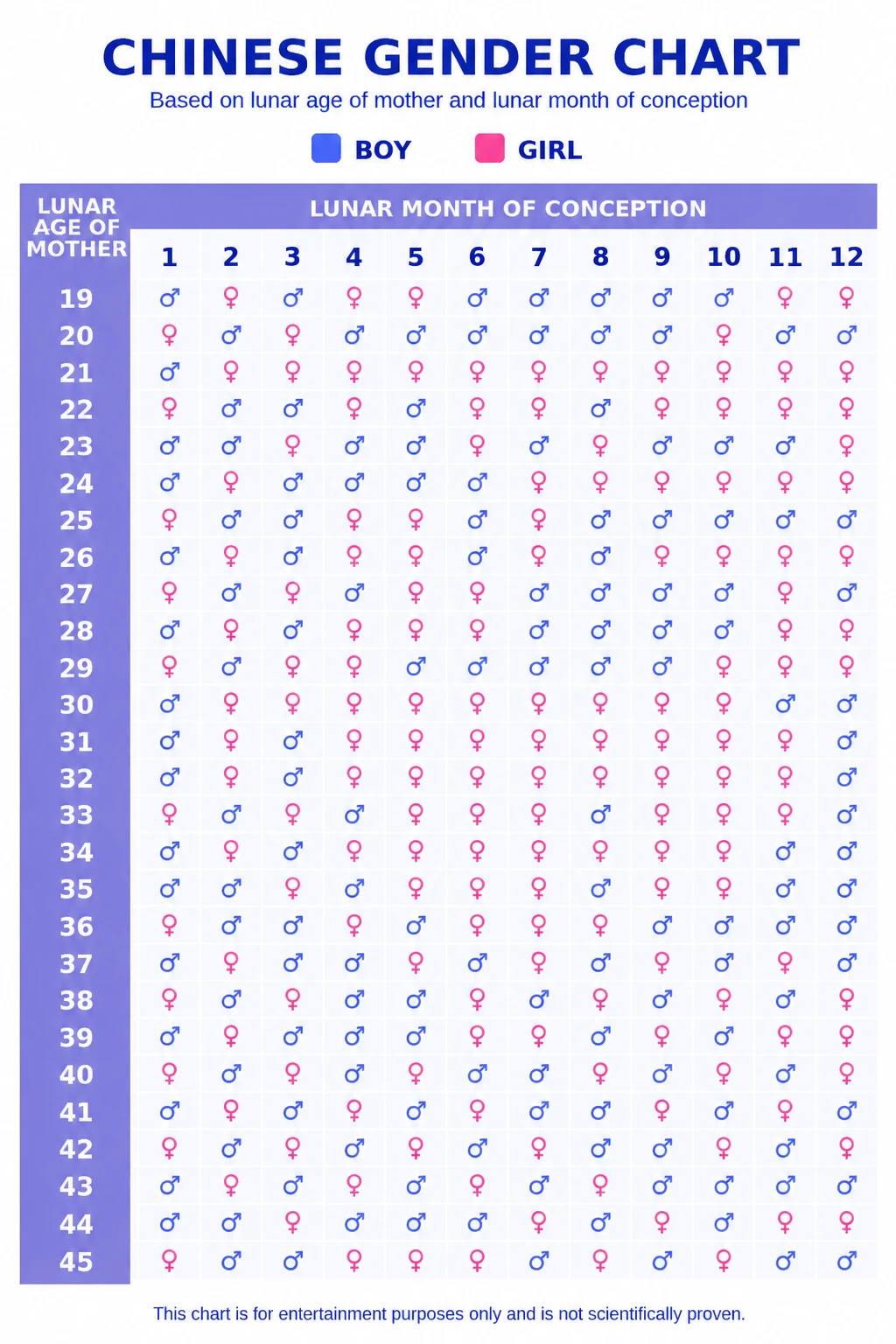
Its structure is part of what keeps it popular. The method feels easy to follow, the result is immediate, and the chart itself is simple to understand. Even parents who treat it purely as a fun tradition often enjoy the clear and visual way it works.
Where Did the Chinese Gender Calendar Come From?
The Chinese Gender Calendar is commonly described as a long-shared tradition connected to ancient China. Many people first encounter it through stories that frame it as an old chart passed down over time.
Because these stories are usually shared as traditional accounts rather than modern medical history, it makes more sense to appreciate the chart for its cultural appeal than to treat it as a scientific source. For most readers, what matters is that it has been remembered and discussed for generations.

A Chinese Gender Calendar old book photo commonly circulated in folk discussions about the Qinggong Chart. It is best understood as a traditional cultural reference rather than a medical or scientific source.
How Does the Chinese Gender Calendar Work?
The Chinese Gender Calendar works by matching two values on the chart:
- the mother’s age
- the conception month
Once those two values are identified, you find where they intersect on the chart to get the prediction.
What makes the method feel more complicated is that the traditional chart is usually based on the lunar calendar, not just the standard calendar used in everyday life. In practice, that means the values used by the chart are often described as the mother’s lunar age and the lunar conception month.
That is why many parents prefer using an online calculator instead of trying to work everything out by hand. On this site, the calculator automatically converts your dates before matching them against the chart, which makes the traditional method much easier to use while staying closer to how the chart is traditionally understood.
If you want to try the method yourself, use our Chinese Gender Calendar Calculator to convert your dates and check the chart more easily.
Is the Chinese Gender Calendar Accurate?
This is the question most parents ask sooner or later.
The most balanced answer is: it can be fun to try, but it should not be treated as a medically reliable answer. A large population-based study found that the Chinese lunar calendar method did not perform better than chance when used to predict fetal sex.[2]
So while the chart remains interesting and enjoyable for many families, it is better thought of as a traditional guessing method than a dependable prediction method.
Is the Chinese Gender Calendar Scientific?
No. The Chinese Gender Calendar is best understood as a traditional or folklore-based prediction method, not a scientific one.
If you want medically reliable information about fetal sex, that comes from clinical methods such as ultrasound and prenatal testing, not from a chart.[1][3][4]
That does not take away the chart’s value as a tradition. For many parents, the Chinese Gender Calendar is enjoyable precisely because it sits somewhere between culture, curiosity, and pregnancy ritual. It can be fun to try, as long as expectations stay realistic.
Is the Chinese Gender Calendar Different Every Year?
This is a very common question, especially when people see searches like Chinese Gender Calendar 2025 or Chinese Gender Calendar 2026 online.
From the perspective of the traditional method, the Chinese Gender Calendar itself is not meant to be a completely different chart every year. Its core logic stays the same because it is based on the lunar calendar system.
However, most people today use standard Gregorian dates in daily life, not lunar dates. For that reason, many websites publish year-specific versions of the chart that are designed around Gregorian calendar use. From that modern calendar perspective, the chart may appear to change from year to year.
The important thing to understand is that these year-based versions are mainly a convenience for modern users. If you want to follow the traditional method more closely, using a simple Gregorian version may introduce errors. A calculator that automatically converts dates for you is usually a more faithful way to reflect how the chart is traditionally used.
Why Do Chinese Gender Charts Look Different Online?
Many parents notice that Chinese gender charts do not always look exactly the same online. Different websites may use different layouts, labels, or year-based presentations, which can make the chart appear inconsistent even when the core idea is similar.
On this site, we use the version that is most commonly shared in everyday Chinese-language discussions and widely seen on Rednote (Xiaohongshu) in China.
Final Thoughts
The Chinese Gender Calendar has remained popular because it is simple, visual, and tied to one of the most natural questions parents ask during pregnancy. It offers a playful way to explore that curiosity while also carrying the charm of a long-shared tradition.
If you are here to understand what the Chinese Gender Calendar is, how it works, and how to read it, you now have the full picture. And if you want to try it for yourself, using a calculator that handles the date conversion automatically is usually the easiest and most practical way to begin.
References
Parents. Can a Chinese Gender Calendar Really Predict the Sex of Your Baby?
https://www.parents.com/chinese-gender-predictor-calendar-chart-8665990
Villamor E, et al. Accuracy of the Chinese lunar calendar method to predict a baby's sex: a population-based study. PubMed:
https://pubmed.ncbi.nlm.nih.gov/20618730/
ACOG. Ultrasound Exams.
https://www.acog.org/womens-health/faqs/ultrasound-exams
Mayo Clinic. Prenatal testing: Is it right for me?
https://www.mayoclinic.org/healthy-lifestyle/pregnancy-week-by-week/in-depth/prenatal-testing/art-20045177